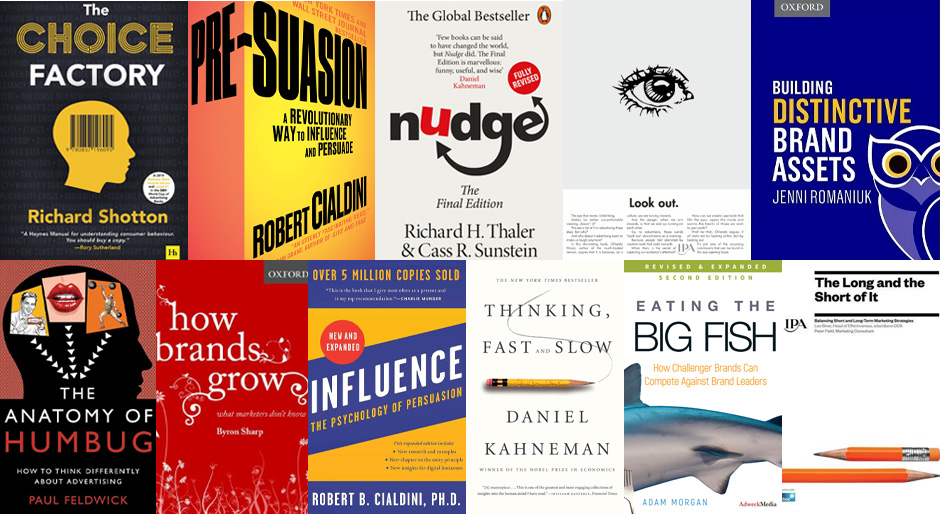
Every year, lists of marketing books appear. Almost all of them repeat the same titles, almost all of them offer the same generic praise, and almost none of them say the most important thing: what does that marketing book change in your work on Monday morning?
This list is different, and it’s different for a simple reason. We work with brands every day and we know how to distinguish a book that makes for a good lunch conversation from a book that changes the way you decide on a budget, write a brief, or evaluate a campaign.
Table os Contents
Here we’ve compiled marketing books that truly influence decisions, organized by function and need, so you can quickly find what you’re looking for. Let’s get started!
Before the list: how to choose a good marketing book
If you only read this section, it’s already worth the read. A marketing book deserves your time when it meets three conditions.
- It is based on serious research: It cites studies, data, and samples. It does not construct a universal theory from three famous companies and a well-told story.
- It changes a concrete decision: After closing it, something starts to be done differently. If not, it was inspiration, and inspiration is great, but it doesn’t pay for campaigns.
- It has been confirmed by others: The conclusions held up when other people tested them in other markets and other categories. This is where many bestsellers fall short.
Keep these three questions in mind. You’ll use them later.
The five books we consider essential.
If you’re starting to build your library, begin with these. They’re the ones that come up repeatedly in our internal conversations and that most influence how we work.
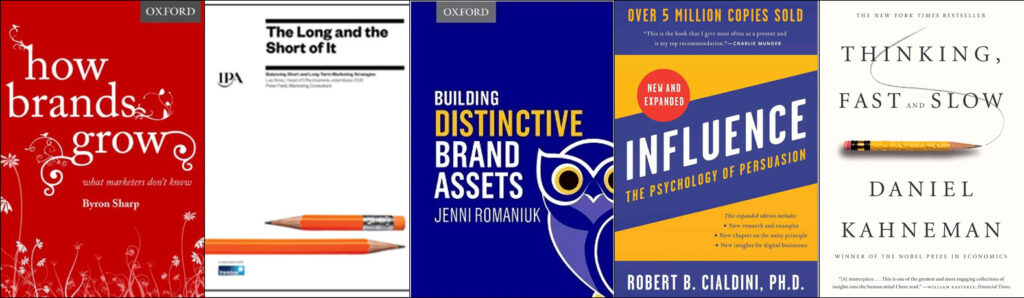
1. How Brands Grow by Byron Sharp
Few books have been as unsettling. His thesis challenges the instincts of brands: growth comes from acquiring new (even occasional) customers, not from retaining existing ones. One fact shatters this illusion: smaller brands have fewer customers and, inevitably, less loyalty. Betting on loyalty as the engine of growth is starting off on the wrong foot.
In practice, this book forces a redefinition of three things: budget allocation, priority metrics, and the briefing for the creative team.
2. The Long and the Short of It by Les Binet and Peter Field
If you’ve ever had to defend brand investment against someone who only looks at immediate returns, this book is your best ally.
Analysis of over a thousand campaigns revealed what many teams feel but can’t prove: activation always wins in the short term, and the brand clearly wins in the medium term. Cutting brand investment to boost performance usually yields excellent results in one quarter and a stagnant graph a year and a half later.
It’s a short book, full of charts, and extremely useful in difficult meetings.
3. Building Distinctive Brand Assets by Jenni Romaniuk
The previous book explains why. This one explains how.
Romaniuk takes the elements that make a brand instantly recognizable—the logo, the color, the typography, the character, the sound, the signature—and shows how to choose, test, and reinforce each one.
For those who work in agencies, it’s gold. It improves briefings, creates objective criteria for creative evaluation, and helps avoid that classic problem of campaigns that everyone remembers without remembering who the brand was.
4. Influence, by Robert Cialdini
You’ve probably heard of the six principles of persuasion. You’ve probably heard of them in a thirty-second summary.
The original is worth much more. Each principle is anchored in published experiences, with context, limitations, and nuances that summaries discard. If you write copy, ads, emails, landing pages, or pricing tables, this is the most profitable book you can read.
A note of honesty: some of the experiments cited in the early editions had more modest results when repeated by other researchers. The most recent editions correct some of this. The essential points remain valid.
5. Thinking, Fast and Slow, by Daniel Kahneman
This is not a marketing book, and that’s precisely why it’s interesting. It explains the mechanics of human decision-making, between fast, automatic thinking and slow, deliberate thinking, which underpins virtually everything else on this list.
It’s dense and requires time. Make up for it by reading slowly. And keep in mind that some of the cited studies did not withstand subsequent scrutiny, something the author himself publicly acknowledged. The conceptual framework remains solid.
The right books for what you need to solve right now.
People don’t always read out of curiosity. Often they read because there’s a problem on the table. Here are our suggestions, born out of necessity.
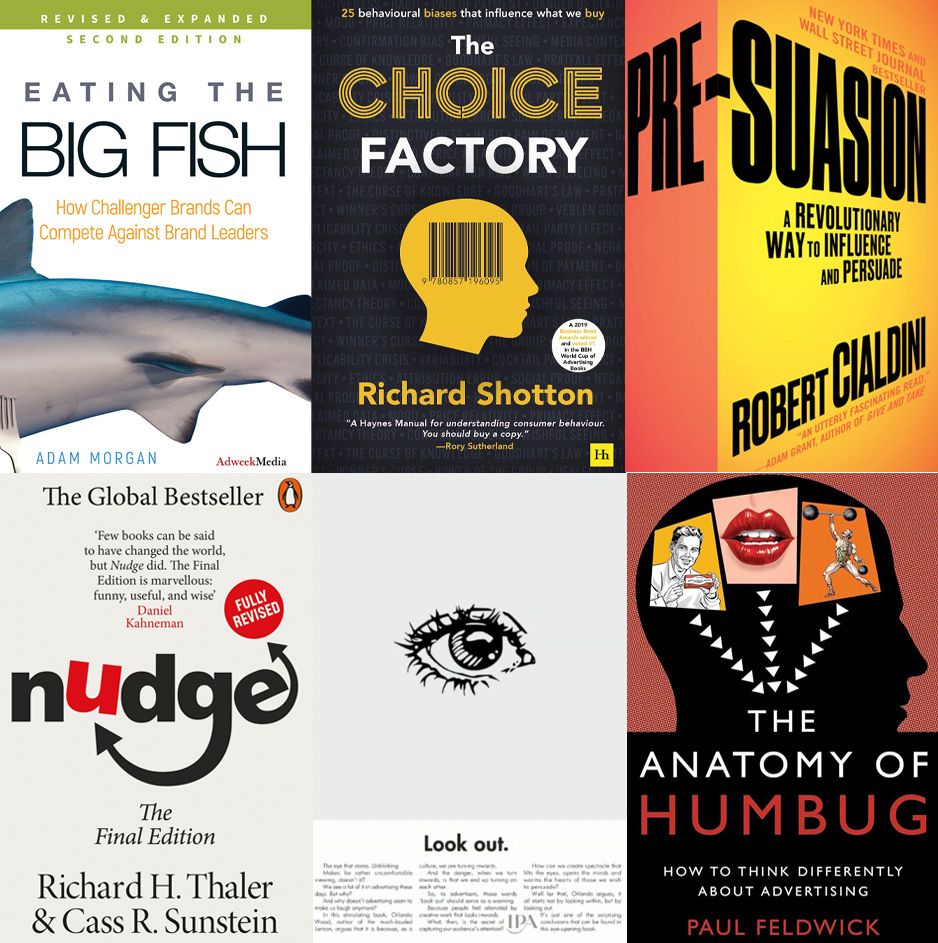
You need to compete with those who have bigger budgets. Adam Morgan’s Eating the Big Fish is the playbook for challenger brands. Very useful for those leading projects with ambitions greater than the available budget.
You need to write better copy. Richard Shotton’s The Choice Factory presents twenty-five behavioral biases with real-world advertising examples. It’s more straightforward than Kahneman and far more rigorous than most neuromarketing books.
You need to structure persuasion throughout the funnel. Pre-Suasion, also by Cialdini, shows how what happens before the message conditions the response to the message.
You need to improve conversion rates on forms, shopping carts, and pricing plans. Nudge, by Thaler and Sunstein, was created for public policy but applies almost literally to any purchase journey.
You need to understand why advertising seems increasingly similar. Lemon and Look Out, by Orlando Wood, analyze the loss of creative effectiveness over the last two decades and the excess of rational and abstract ads compared to those with emotion, character, and place. Read them together.
It requires context and industry knowledge. Paul Feldwick’s “The Anatomy of Humbug” dismantles long-held advertising myths. It’s especially enjoyable for those who have been around for a while.
Where to begin, depending on your role.
No one needs to read fifty books. They need to read eight or ten well-chosen ones and return to them from time to time with new cases in mind.
If you’re managing a brand: start with How Brands Grow, move on to Building Distinctive Brand Assets, and then add The Long and the Short of It.
If you’re a marketing leader: Read How Brands Grow and The Long and the Short of It first, then The Anatomy of Humbug to gain perspective on the industry.
If you are an entrepreneur or manage an SME: How Brands Grow to let go of unrealistic expectations, Influence for copywriting and pricing, and Eating the Big Fish to compete with those who have more resources.
If you work in performance, read The Long and the Short of It above all else, because it’s the book that helps you avoid the most expensive mistake in this field.
If you’re just starting out: Influence and The Choice Factory are the ones that deliver visible results the fastest.
Marketing books in Portuguese: what to check before buying
It’s worth checking before ordering. Some of the best-known titles on this list have Portuguese editions, namely those by Cialdini, Kahneman, Ariely, Godin, and Sinek, although it’s not always clear whether the available edition is Portuguese or Brazilian. Confirm before buying.
Many of the more technical titles continue to exist only in English. The good news is that the writing is accessible, and an intermediate level is perfectly sufficient.
One last practical tip: the most operational books, full of diagrams, tables, and checklists, work much better in print than as audiobooks. Save the audiobooks for the more narrative titles.
There’s one idea that runs through all the books on this list: marketing works best when it’s based on evidence, not on well-told intuition.
This is how we work at Up We Go. We help brands transform strategy into concrete results, with social media management, SEO, strategic content, online advertising, design and branding, and the creation of websites and online stores.
If you want to apply these principles to your business, with a team that uses them every day, talk to us . Let’s grow together.


