
You invest in ads, post on social media, and create content, but at the end of the month, the question remains: what brought results? Performance marketing answers this question because each action has clear objectives and numbers that show the return.
You don’t need to be a data expert to benefit from this approach. You just need to understand what to measure, how to interpret the results, and when to adjust course.
In this article you will discover what performance marketing is, what advantages it brings to your business, four strategies to put it into practice, and the metrics you should closely monitor.
What is Performance Marketing?
Performance marketing is a digital marketing approach where all actions are geared towards measurable results. Instead of investing “blindly,” the brand defines concrete goals (sales, contacts, registrations) and tracks the data to understand what works.
A simple example: writing a blog article is content marketing. Writing that article based on keyword research, to appear in the top Google search results and generate leads, is already thinking about performance.
The principle is always the same: measure, analyze, and optimize. Every euro invested must have a reason for being and a trackable result.
Advantages of Performance Marketing
In a market where the public’s attention is fought for down to the second, working with data gives you a clear advantage. These are the three main ones.
Real-time analysis
Digital platforms allow you to see, almost in real time, how your campaigns are performing. Tools like Google Analytics show you how many people are on your website, where they come from, and what they are doing there.
This means you don’t need to wait until the end of a campaign to know if it’s going well. The data is available while the campaign is running.
Rapid changes
If an ad isn’t converting or if an audience is responding better than expected, you can adjust it right away. For example, you can:
- Pause the worst-performing ads and reinforce the ones that are working;
- To change the image or text of a campaign;
- Redistribute the budget across channels (Google, Instagram, Facebook).
This flexibility prevents budget waste and allows for course correction in time.
Tangible result
With performance marketing, results cease to be mere impressions and become concrete numbers. You know how many leads you generated, how much each lead cost, and what revenue each campaign brought in.
This simplifies investment decisions and makes it much easier to justify the marketing budget to management.

4 Performance Marketing Strategies
Now that you know the advantages, see how to apply performance marketing in your brand’s day-to-day operations.
1. Defining and monitoring KPIs
KPIs (Key Performance Indicators) are the numbers that show whether you are achieving your goals. Choosing the right ones is the first step .
Start by answering three questions:
- What is the main objective? To sell more, generate leads, increase website traffic?
- What number indicates success? For example, 100 quote requests per month.
- Where do you start? Use historical data or, if you don’t have it, market research from your industry.
Then, monitor these indicators regularly.
2. Target audience segmentation
Segmentation is the process of dividing the audience into groups with similar characteristics: age, location, interests, purchasing behavior. The more targeted the audience, the greater the likelihood of repeat business.
In practice, a restaurant in Porto doesn’t need to show ads to people living in the Algarve. An online baby clothing store can focus on parents with young children. Platforms like Meta’s Ads Manager allow for this level of detail.
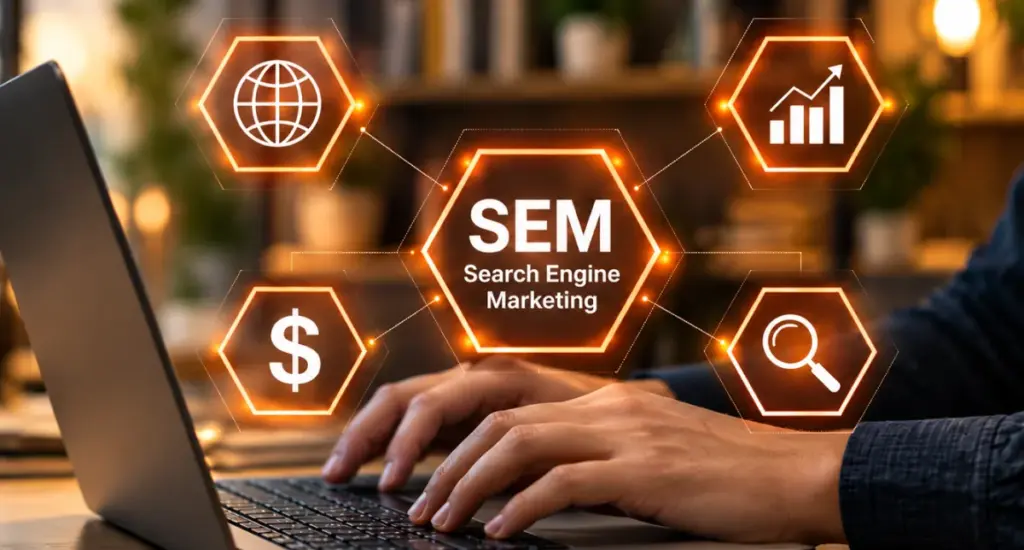
3. SEM (Search Engine Marketing)
SEM is search engine marketing, such as for Google. It combines two approaches:
- SEO (search engine optimization) : work on the website and its content to appear in organic search results, without paying per click.
- Paid advertising (PPC, or pay-per-click): ads on Google Ads that appear when someone searches for terms related to your business.
The combination of the two is powerful: ads bring quick results, while SEO builds long-term visibility. For keyword research and monitoring the competition, Semrush is one of the most comprehensive tools.
4. Marketing Automation
Marketing automation uses tools to automatically perform repetitive tasks: sending welcome emails, reminding customers of an abandoned shopping cart, or segmenting contacts based on their behavior.
The result is more personalized communication, at the right time, without overwhelming your team. Platforms like Brevo or HubSpot are good options, both for those who are starting out and for growing businesses.
Most important metrics to measure
Not all metrics carry the same weight. The most relevant ones depend on your objective, but these are the essential ones:
- CPC (cost per click): how much you pay, on average, for each click on an ad.
- CPM (cost per thousand impressions): how much it costs to show the ad a thousand times. Useful in brand awareness campaigns.
- CTR (click-through rate): the percentage of people who saw the ad and clicked on it. It shows whether the message is appealing.
- Conversion rate: the percentage of visitors who complete the intended action (purchase, fill out a form).
- CPL (cost per lead): how much does it cost to generate a new interested contact.
- CPA (cost per acquisition): how much does it cost to acquire a new customer.
- ROAS (Return on Ad Spend): The revenue generated for every euro spent on advertising.
- ROI (return on investment): the profit relative to the total investment.
- LTV (Customer Lifetime Value): how much a customer is worth to your brand throughout the entire relationship.
A practical example: you invested €500 in a campaign that generated 50 leads and €2,000 in sales. Your CPL was €10 and your ROAS was 4 (meaning, for every euro invested, you received four).
To properly set up conversion tracking on your website, the Google Analytics help center is a good starting point.
Performance marketing isn’t just for large companies with teams of analysts. Any brand can get started: define a clear objective, choose two or three KPIs, and track them weekly.
Over time, you’ll find that decisions become easier and your budget stretches further.
If you prefer to have a team handle this for you, Up We Go manages online advertising campaigns with a dashboard where you can see the results and budget invested in real time. Talk to us and take the next step to grow your brand with data.